
Top Stories
Wood Mackenzie Predicts Decline in UK’s North Sea Oil Investment

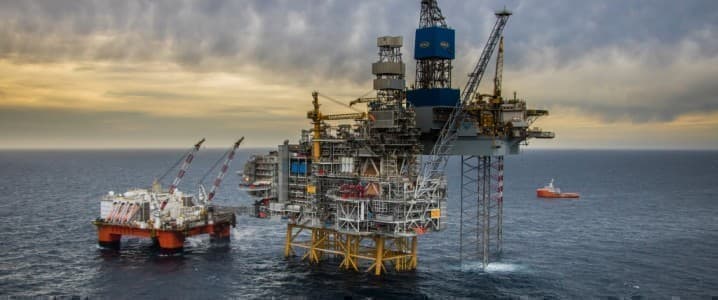
The oil and gas sector in the UK North Sea is set to experience a significant decline in capital expenditure, according to a new report by Wood Mackenzie. This comes as the industry grapples with aging oil fields, falling production levels, and increasing reliance on imports. The North Sea’s output has decreased sharply since its peak in the early 2000s, leading to concerns over the future of UK energy security.
The North Sea Transition Authority (NSTA), the UK’s energy regulator, reported that the North Sea had approximately 2.9 billion barrels of oil equivalent left at the end of 2024. This figure suggests that the UK does not have centuries of oil reserves, as suggested by past statements from U.S. President Donald Trump. Wood Mackenzie forecasts that 2026 could mark the last year in which the UK produces over 1 million barrels of oil equivalent per day (boe/d) from the North Sea.
The decline in production has been attributed to several factors, including reduced investment, job losses, and the high costs associated with energy extraction. This has intensified the UK’s dependence on energy imports, despite ongoing efforts to transition to alternative energy sources. The Energy Profits Levy (EPL), introduced in 2022, has added to the challenge, creating uncertainty in the market. The EPL imposes a temporary windfall tax of 78% on exceptional profits from UK oil and gas producers, and while it is scheduled to end by March 2030, it will be replaced by a new Oil and Gas Price Mechanism (OGPM) that will apply a 35% charge during periods of high prices.
Investment trends in the North Sea are expected to diverge significantly between the UK and Norway. Wood Mackenzie predicts that UK investment will fall below $3.5 billion in 2026, marking its lowest real terms level since the 1970s. Conversely, Norway is projected to maintain strong development spending of around $20 billion, focusing on major projects that will help secure gas supply for Europe.
Investment Trends and Market Dynamics
The differing trajectories of investment reflect the contrasting regulatory environments in the UK and Norway. The UK’s challenging fiscal framework and policy uncertainties are driving companies to reconsider their investments, while Norway benefits from a more stable regulatory climate and a robust project pipeline. Despite the anticipated drop in investment, Wood Mackenzie estimates that total North Sea production will remain steady at around 5.3 million boe/d in 2026, buoyed by new projects in both countries.
Norway’s production is expected to plateau at approximately 4.1 million boe/d, with significant contributions from projects such as Equinor’s Johan Castberg and Var Energi’s Balder redevelopment, which together will account for over 50% of the new volume. Notably, Equinor’s 136 million boe Irpa gas field is highlighted as a critical project scheduled to come online this year.
Mergers, Acquisitions, and Industry Restructuring
The uncertainty in the market is likely to drive further mergers and acquisitions (M&A), particularly in the UK, where weaker players may consolidate. Stronger companies are expected to acquire non-core assets, leveraging tax losses and decommissioning relief to improve their financial positions. In contrast, Norway’s market is anticipated to see more limited asset deals.
As operators navigate the challenges posed by lower oil prices—predicted to average between $57 and $59 per barrel—there will be a heightened focus on capital discipline and operational efficiency. Companies are likely to prioritize investments in high-return projects, such as brownfield expansions and near-field tie-backs, to enhance profitability in a constrained price environment.
The industry is also facing intensified pressures regarding the energy transition and decarbonization. There is increasing scrutiny on climate impact, with growing interest in Carbon Capture, Utilisation, and Storage (CCUS) projects, along with calls for new policies on Scope 3 emissions reporting, particularly in Norway. The electrification of offshore operations and the integration of renewable energy sources are becoming more prevalent as companies aim to meet environmental, social, and governance (ESG) metrics.
Exploration activity is projected to be predominantly Norwegian, with operators planning to drill over 30 exploration wells in 2026. This contrasts sharply with the UK Continental Shelf, which saw no exploration wells drilled in 2025. Norwegian exploration efforts are focused on high-impact prospects that offer clear pathways to development, including appraisal wells on existing discoveries, which could unlock significant gas supplies for Europe.
As the North Sea oil and gas sector navigates these challenges, the implications for energy security, investment, and environmental responsibility will be crucial areas of focus for stakeholders across the industry. The outlook for 2026 will depend heavily on the ability of companies to adapt to a rapidly changing landscape while maintaining production and exploring new opportunities for growth.

iShares Core Dividend Growth ETF Faces Challenges; Alternatives Suggested

Discover 7 Scenic Hikes Near Calgary to Explore This Spring

Scientists Uncover Life’s Building Blocks in Ryugu Asteroid Samples

Windsor-Essex Unveils New Action Plan to Combat Substance Use

Boost Your Business Visibility with These Local SEO Strategies

East Algoma OPP Urges Public to Limit Travel Amid Hazardous Conditions

Universities Must Rethink Failure to Support Student Growth

Canada Invests $6.4 Million to Boost Green Shipping Corridors

Stony Plain Secures 14th Consecutive Award for Financial Reporting Excellence

Rhythm Pharmaceuticals Reports Strong Q4 Growth Ahead of FDA Decision

Brandon University’s Failed $5 Million Project Sparks Oversight Review

Microsoft Confirms U.S. Law Overrules Canadian Data Sovereignty

Winnipeg Celebrates Culinary Creativity During Le Burger Week 2025

Discover Aritzia’s Latest Fashion Trends: A Comprehensive Review

New SĆIȺNEW̱ SṮEȽIṮḴEȽ Elementary Opens in Langford for 2025/2026 Year

EngineAI Unveils T800 Humanoid Robot, Setting New Industry Standards

Montreal’s Groupe Marcelle Leads Canadian Cosmetic Industry Growth

Tech Innovator Amandipp Singh Transforms Hiring for Disabled

Dragon Ball: Sparking! Zero Launching on Switch and Switch 2 This November

Digg Relaunches as Founders Kevin Rose and Alexis Ohanian Join Forces
-
 Education7 months ago
Brandon University’s Failed $5 Million Project Sparks Oversight Review
-
 Science8 months ago
Microsoft Confirms U.S. Law Overrules Canadian Data Sovereignty
-
 Lifestyle7 months ago
Winnipeg Celebrates Culinary Creativity During Le Burger Week 2025
-
 Lifestyle4 months ago
Discover Aritzia’s Latest Fashion Trends: A Comprehensive Review
-
 Education8 months ago
New SĆIȺNEW̱ SṮEȽIṮḴEȽ Elementary Opens in Langford for 2025/2026 Year
-
 Business4 months ago
EngineAI Unveils T800 Humanoid Robot, Setting New Industry Standards
-
 Health8 months ago
Montreal’s Groupe Marcelle Leads Canadian Cosmetic Industry Growth
-
 Science8 months ago
Tech Innovator Amandipp Singh Transforms Hiring for Disabled
-
 Technology8 months ago
Dragon Ball: Sparking! Zero Launching on Switch and Switch 2 This November
-
 Technology3 months ago
Digg Relaunches as Founders Kevin Rose and Alexis Ohanian Join Forces
-

 Lifestyle4 weeks ago
Canmore’s Le Fournil Bakery to Close After 14 Successful Years
-
 Top Stories4 months ago
Canadiens Eye Elias Pettersson: What It Would Cost to Acquire Him
-

 Health7 months ago
Eganville Leader to Close in 2026 After 123 Years of Reporting
-

 Education8 months ago
Red River College Launches New Programs to Address Industry Needs
-

 Top Stories4 months ago
Nicol Brothers Shine as Wheat Kings Dominate U18 AAA Hockey
-

 Business8 months ago
BNA Brewing to Open New Bowling Alley in Downtown Penticton
-

 Business7 months ago
Rocket Lab Reports Strong Q2 2025 Revenue Growth and Future Plans
-

 Education6 months ago
Alberta Petition Aims to Redirect Funds from Private to Public Schools
-

 Lifestyle5 months ago
Edmonton’s Beloved Evolution Wonderlounge Closes, New Era Begins
-

 Education8 months ago
Alberta Teachers’ Strike: Potential Impacts on Students and Families
-

 Technology6 months ago
Discord Faces Serious Security Breach Affecting Millions
-

 Technology8 months ago
Google Pixel 10 Pro Fold Specs Unveiled Ahead of Launch
-

 Business7 months ago
Iconic Golden Lion Restaurant in South Surrey to Close After 50 Years
-

 Science8 months ago
China’s Wukong Spacesuit Sets New Standard for AI in Space