
Science
Japanese Researchers Claim Breakthrough in Dark Matter Detection

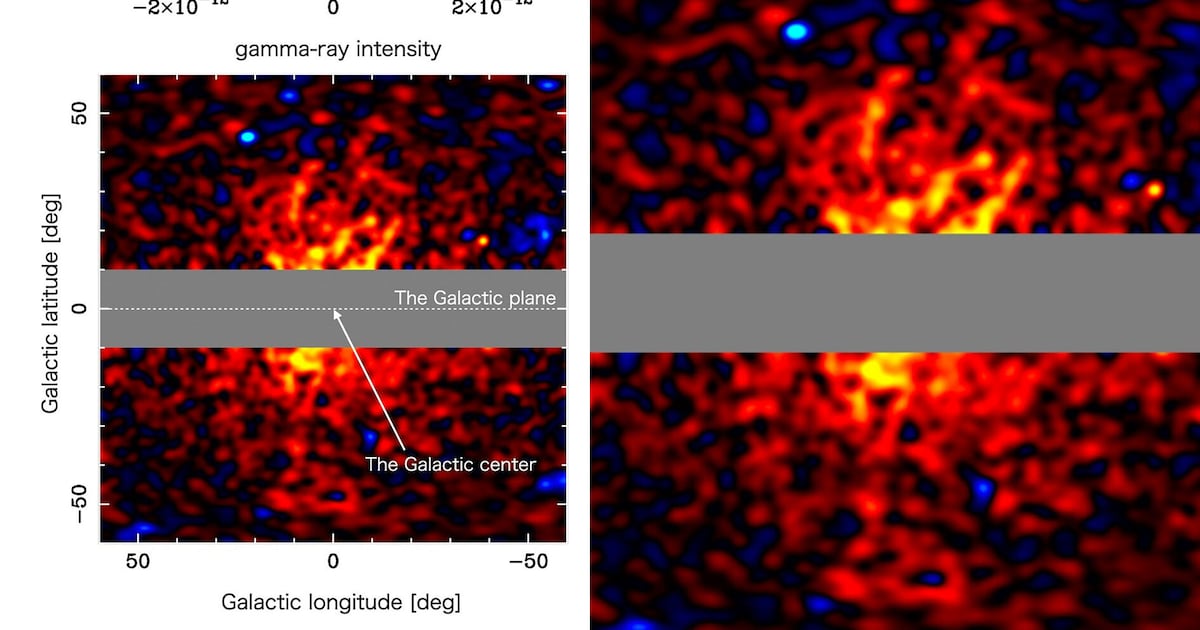
Researchers at the University of Tokyo have made significant strides in the quest to understand dark matter, a mysterious substance that has puzzled scientists since the 1930s. Utilizing data from the NASA Fermi Gamma-ray Space Telescope, the team believes they have detected signs of dark matter for the first time. This invisible material is thought to constitute a majority of the universe’s mass and is often described as the “invisible glue that holds the universe together.”
Breakthrough Findings on Dark Matter
The term “dark matter” was first introduced by Swiss astronomer Fritz Zwicky, who suggested its existence based on gravitational effects observed in galaxies. Unlike ordinary matter, dark matter does not emit, absorb, or reflect light, making it challenging to study directly. Instead, scientists have inferred its presence through its influence on visible matter, such as the gravitational forces that keep galaxies intact.
Current theories propose that dark matter consists of weakly interacting massive particles, commonly known as WIMPs. These particles, which are heavier than protons, interact minimally with other forms of matter. When two WIMPs collide, they are expected to annihilate one another, resulting in the emission of other particles, including gamma ray photons.
Led by astronomer and astrophysicist Tomonori Totani, the research team focused on areas of the Milky Way with high concentrations of dark matter. After years of investigation, they believe they have identified specific gamma rays that align with predictions regarding the annihilation of dark matter particles. “We detected gamma rays with a photon energy of 20 gigaelectronvolts, extending in a halo-like structure toward the centre of the Milky Way galaxy,” Totani stated in a press release. “The gamma-ray emission component closely matches the shape expected from the dark matter halo.”
Implications and Further Verification
The gamma-ray findings present a compelling case that cannot be easily attributed to conventional astronomical phenomena or emissions. Totani expressed optimism about the implications of this discovery, suggesting it could represent humanity’s first direct observation of dark matter. “If this is correct, it would mark the first time humanity has ‘seen’ dark matter,” he noted. “This signifies a major development in astronomy and physics.” The study has been published in the Journal of Cosmology and Astroparticle Physics.
Despite the promising results, the findings must undergo independent verification by other researchers. Yonatan Kahn, an assistant professor of physics at the University of Toronto, highlighted the importance of consistency in research. He stated, “What this paper is purporting to show is they saw signatures of dark matter particles that were annihilating to other particles that we are then able to observe with this telescope.”
Kahn raised some concerns regarding the research’s alignment with previous studies that examined similar regions of the galaxy but did not achieve definitive results. “The general idea has definitely been tried before, so it’s not necessarily an entirely new data set nor a new observational technique,” he explained. “It’s a new analysis that needs to be checked against existing literature.”
The pursuit of understanding dark matter continues to be a vital area of research in astrophysics. As scientists work to unravel this cosmic mystery, the findings from the University of Tokyo could pave the way for groundbreaking discoveries that reshape our understanding of the universe.

iShares Core Dividend Growth ETF Faces Challenges; Alternatives Suggested

Discover 7 Scenic Hikes Near Calgary to Explore This Spring

Scientists Uncover Life’s Building Blocks in Ryugu Asteroid Samples

Windsor-Essex Unveils New Action Plan to Combat Substance Use

Boost Your Business Visibility with These Local SEO Strategies

East Algoma OPP Urges Public to Limit Travel Amid Hazardous Conditions

Universities Must Rethink Failure to Support Student Growth

Canada Invests $6.4 Million to Boost Green Shipping Corridors

Stony Plain Secures 14th Consecutive Award for Financial Reporting Excellence

Rhythm Pharmaceuticals Reports Strong Q4 Growth Ahead of FDA Decision

Brandon University’s Failed $5 Million Project Sparks Oversight Review

Microsoft Confirms U.S. Law Overrules Canadian Data Sovereignty

Discover Aritzia’s Latest Fashion Trends: A Comprehensive Review

Winnipeg Celebrates Culinary Creativity During Le Burger Week 2025

New SĆIȺNEW̱ SṮEȽIṮḴEȽ Elementary Opens in Langford for 2025/2026 Year

EngineAI Unveils T800 Humanoid Robot, Setting New Industry Standards

Montreal’s Groupe Marcelle Leads Canadian Cosmetic Industry Growth

Tech Innovator Amandipp Singh Transforms Hiring for Disabled

Canmore’s Le Fournil Bakery to Close After 14 Successful Years

Dragon Ball: Sparking! Zero Launching on Switch and Switch 2 This November
-
 Education8 months ago
Brandon University’s Failed $5 Million Project Sparks Oversight Review
-
 Science9 months ago
Microsoft Confirms U.S. Law Overrules Canadian Data Sovereignty
-
 Lifestyle4 months ago
Discover Aritzia’s Latest Fashion Trends: A Comprehensive Review
-
 Lifestyle8 months ago
Winnipeg Celebrates Culinary Creativity During Le Burger Week 2025
-
 Education8 months ago
New SĆIȺNEW̱ SṮEȽIṮḴEȽ Elementary Opens in Langford for 2025/2026 Year
-
 Business5 months ago
EngineAI Unveils T800 Humanoid Robot, Setting New Industry Standards
-
 Health9 months ago
Montreal’s Groupe Marcelle Leads Canadian Cosmetic Industry Growth
-
 Science9 months ago
Tech Innovator Amandipp Singh Transforms Hiring for Disabled
-
 Lifestyle2 months ago
Canmore’s Le Fournil Bakery to Close After 14 Successful Years
-
 Technology9 months ago
Dragon Ball: Sparking! Zero Launching on Switch and Switch 2 This November
-

 Technology4 months ago
Digg Relaunches as Founders Kevin Rose and Alexis Ohanian Join Forces
-
 Top Stories5 months ago
Canadiens Eye Elias Pettersson: What It Would Cost to Acquire Him
-

 Health7 months ago
Eganville Leader to Close in 2026 After 123 Years of Reporting
-

 Lifestyle6 months ago
Edmonton’s Beloved Evolution Wonderlounge Closes, New Era Begins
-

 Top Stories5 months ago
Nicol Brothers Shine as Wheat Kings Dominate U18 AAA Hockey
-

 Education8 months ago
Red River College Launches New Programs to Address Industry Needs
-

 Business8 months ago
BNA Brewing to Open New Bowling Alley in Downtown Penticton
-

 Business8 months ago
Rocket Lab Reports Strong Q2 2025 Revenue Growth and Future Plans
-

 Education6 months ago
Alberta Petition Aims to Redirect Funds from Private to Public Schools
-

 Education8 months ago
Alberta Teachers’ Strike: Potential Impacts on Students and Families
-

 Technology7 months ago
Discord Faces Serious Security Breach Affecting Millions
-

 Technology9 months ago
Google Pixel 10 Pro Fold Specs Unveiled Ahead of Launch
-

 Education5 months ago
ʔaq̓am Education Law Enacted, Affirming Self-Governance Rights
-

 Business8 months ago
Iconic Golden Lion Restaurant in South Surrey to Close After 50 Years