
Top Stories
Asian Markets Plummet Following Wall Street’s Sharp Decline

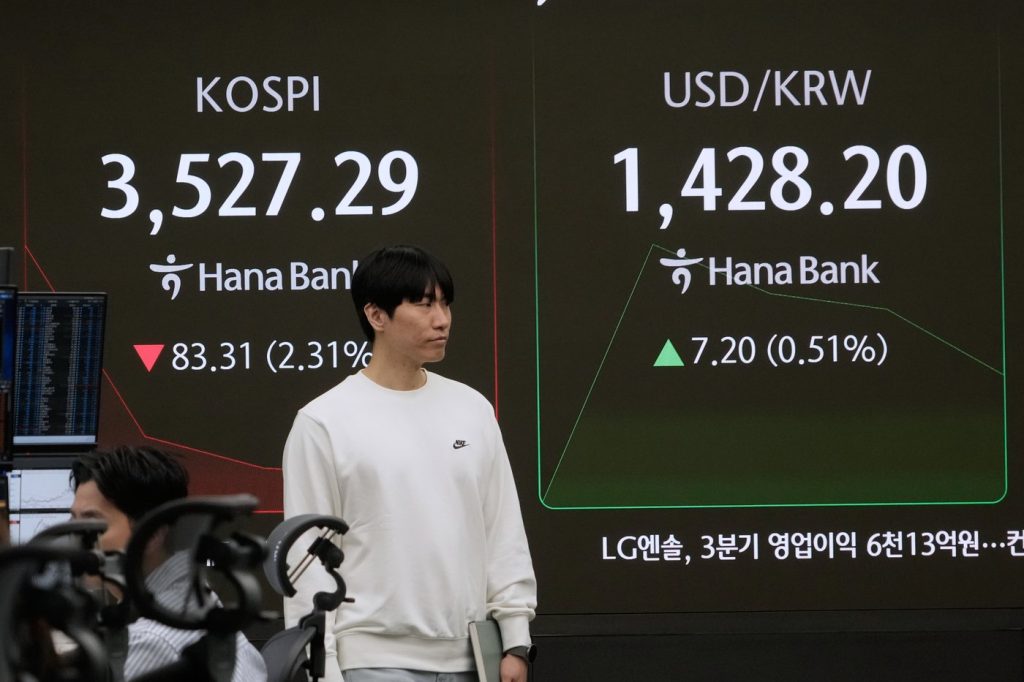
Asian shares fell sharply on Monday, reflecting a significant downturn on Wall Street that marked its worst trading day since April. This decline was largely driven by escalating trade tensions with China, following threats from U.S. President Donald Trump to increase tariffs on Chinese goods. The announcement came in response to China’s new restrictions on exports of rare earth materials, which are essential for various industries, including electronics and aerospace.
In the United States, stocks experienced a notable drop on Friday. The S&P 500 fell by 2.7%, closing at 6,552.51, while the Dow Jones Industrial Average decreased by 1.9% to 45,479.60. The Nasdaq Composite faced an even steeper decline, losing 3.6% and finishing at 22,204.43. These losses indicated growing concerns about a renewed trade war between the two largest economies in the world.
China’s trade data revealed contrasting trends. While global exports rose by 8.3% in September compared to the previous year, marking the strongest growth in six months, exports to the United States plummeted by 27% year-on-year. This shift highlights a strategic pivot by Chinese manufacturers, seeking to diversify their markets away from U.S. dependency.
In response to the turmoil, Asian markets reacted negatively. The Hang Seng index in Hong Kong dropped 3.5% to 25,374.00. Other major markets also recorded losses, including the Shanghai Composite, which fell 1.3% to 3,846.25, and South Korea’s Kospi, which declined 1.7% to 3,550.32. The Australian S&P/ASX 200 decreased by 0.9% to 8,882.60, while Taiwan’s Taiex lost 1.7% and India’s Sensex was down 0.5%. Notably, markets in Tokyo were closed for a holiday.
Trump’s comments on social media added to the market’s unease. He stated, “We have been contacted by other countries who are extremely angry at this great trade hostility, which came out of nowhere.” His remarks hinted at potential diplomatic fallout from the escalating tensions, as he suggested that there was “now no reason” to meet with Chinese President Xi Jinping during an upcoming trip to South Korea.
The tech sector faced particularly heavy losses, with significant declines in stocks of major companies like Nvidia and Apple. Roughly six out of every seven stocks in the S&P 500 experienced a downturn, raising concerns over whether stock prices had become inflated relative to corporate earnings.
In the oil markets, prices also demonstrated volatility. The price of a barrel of benchmark U.S. crude fell by 4.2% to $58.90, influenced by a ceasefire between Israel and Hamas that could alleviate concerns regarding oil supply disruptions. Following Trump’s tariff threats, further declines accelerated, with Brent crude, the international standard, decreasing by 3.8% to $62.73. However, early Monday trading saw prices recover slightly, with U.S. crude trading at $59.78 per barrel and Brent at $63.65.
In the bond market, the yield on the 10-year Treasury note decreased to 4.05% from 4.14%, suggesting investor caution amid economic uncertainty. This decline followed a report from the University of Michigan indicating that consumer sentiment in the U.S. remains low.
Currency markets also reflected this turbulence, with the dollar slipping to 151.87 Japanese yen, while the euro strengthened to $1.1627.
As the situation unfolds, the global financial landscape remains under scrutiny, with investors closely monitoring developments in U.S.-China relations and their potential impact on economic stability.

iShares Core Dividend Growth ETF Faces Challenges; Alternatives Suggested

Discover 7 Scenic Hikes Near Calgary to Explore This Spring

Scientists Uncover Life’s Building Blocks in Ryugu Asteroid Samples

Windsor-Essex Unveils New Action Plan to Combat Substance Use

Boost Your Business Visibility with These Local SEO Strategies

East Algoma OPP Urges Public to Limit Travel Amid Hazardous Conditions

Universities Must Rethink Failure to Support Student Growth

Canada Invests $6.4 Million to Boost Green Shipping Corridors

Stony Plain Secures 14th Consecutive Award for Financial Reporting Excellence

Rhythm Pharmaceuticals Reports Strong Q4 Growth Ahead of FDA Decision

Brandon University’s Failed $5 Million Project Sparks Oversight Review

Microsoft Confirms U.S. Law Overrules Canadian Data Sovereignty

Discover Aritzia’s Latest Fashion Trends: A Comprehensive Review

Winnipeg Celebrates Culinary Creativity During Le Burger Week 2025

New SĆIȺNEW̱ SṮEȽIṮḴEȽ Elementary Opens in Langford for 2025/2026 Year

EngineAI Unveils T800 Humanoid Robot, Setting New Industry Standards

Montreal’s Groupe Marcelle Leads Canadian Cosmetic Industry Growth

Tech Innovator Amandipp Singh Transforms Hiring for Disabled

Canmore’s Le Fournil Bakery to Close After 14 Successful Years

Dragon Ball: Sparking! Zero Launching on Switch and Switch 2 This November
-
 Education8 months ago
Brandon University’s Failed $5 Million Project Sparks Oversight Review
-
 Science9 months ago
Microsoft Confirms U.S. Law Overrules Canadian Data Sovereignty
-
 Lifestyle4 months ago
Discover Aritzia’s Latest Fashion Trends: A Comprehensive Review
-
 Lifestyle8 months ago
Winnipeg Celebrates Culinary Creativity During Le Burger Week 2025
-
 Education8 months ago
New SĆIȺNEW̱ SṮEȽIṮḴEȽ Elementary Opens in Langford for 2025/2026 Year
-
 Business5 months ago
EngineAI Unveils T800 Humanoid Robot, Setting New Industry Standards
-
 Health9 months ago
Montreal’s Groupe Marcelle Leads Canadian Cosmetic Industry Growth
-
 Science9 months ago
Tech Innovator Amandipp Singh Transforms Hiring for Disabled
-
 Lifestyle2 months ago
Canmore’s Le Fournil Bakery to Close After 14 Successful Years
-
 Technology9 months ago
Dragon Ball: Sparking! Zero Launching on Switch and Switch 2 This November
-

 Technology4 months ago
Digg Relaunches as Founders Kevin Rose and Alexis Ohanian Join Forces
-
 Top Stories5 months ago
Canadiens Eye Elias Pettersson: What It Would Cost to Acquire Him
-

 Lifestyle6 months ago
Edmonton’s Beloved Evolution Wonderlounge Closes, New Era Begins
-

 Health7 months ago
Eganville Leader to Close in 2026 After 123 Years of Reporting
-

 Top Stories5 months ago
Nicol Brothers Shine as Wheat Kings Dominate U18 AAA Hockey
-

 Education9 months ago
Red River College Launches New Programs to Address Industry Needs
-

 Business9 months ago
BNA Brewing to Open New Bowling Alley in Downtown Penticton
-

 Business8 months ago
Rocket Lab Reports Strong Q2 2025 Revenue Growth and Future Plans
-

 Education7 months ago
Alberta Petition Aims to Redirect Funds from Private to Public Schools
-

 Education9 months ago
Alberta Teachers’ Strike: Potential Impacts on Students and Families
-

 Technology7 months ago
Discord Faces Serious Security Breach Affecting Millions
-

 Technology9 months ago
Google Pixel 10 Pro Fold Specs Unveiled Ahead of Launch
-

 Education7 months ago
Durham Schools Urged to Reconsider Prom Cancellation After Student Protest
-

 Education5 months ago
ʔaq̓am Education Law Enacted, Affirming Self-Governance Rights