
Science
Amazon Advances AI with Custom Chips from Texas Facility

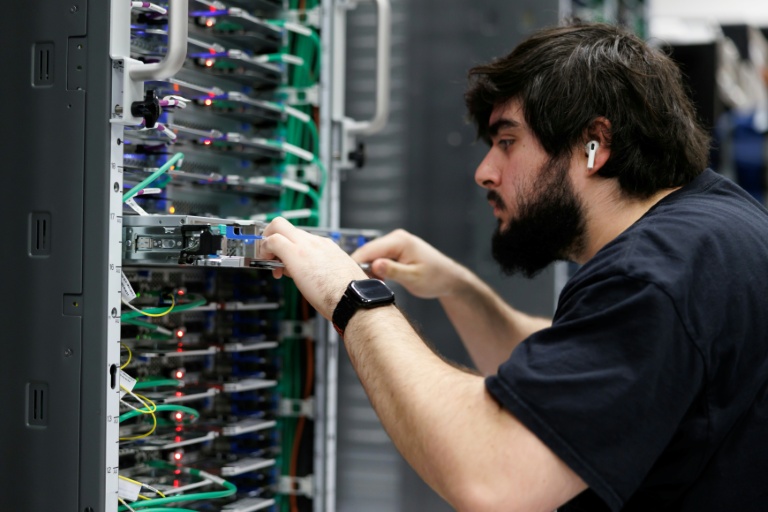
Amazon is intensifying its efforts in the artificial intelligence (AI) sector by developing custom chips known as “Trainium” at its Annapurna Labs facility in Austin, Texas. This initiative is part of a broader strategy to lessen its reliance on Nvidia, a dominant player in the market. The company is investing heavily in AI technologies and recently showcased its latest advancements during a visit by AFP.
Texas is becoming a significant hub for technology investment, attracting companies with its affordable energy, favorable regulations, tax incentives, and reasonably priced real estate suitable for large data centers. At the Annapurna Labs, UltraServers equipped with 144 Trainium AI-accelerator chips were undergoing performance checks ahead of their delivery.
The development of the Trainium chips began after Amazon Web Services (AWS) made the strategic decision to design its own chips following the acquisition of Israeli startup Annapurna Labs in 2015. The initial products, Graviton and Inferentia chips, were launched in 2018, targeting general cloud computing and AI model operations, respectively. The first generation of Trainium chips was introduced in 2020, and a second generation followed, promising significant performance enhancements.
The latest Trainium 3 chips, activated in December 2023, are reported to double the capabilities of the previous generation while being compact in size, similar to a credit card. Kristopher King, head of Annapurna Labs, noted that these chips could reduce the costs associated with developing and running generative AI models by as much as 40% compared to traditional graphics processing units (GPUs).
Reliability and Customization in AI
As AWS aims to capture a significant share of the AI market, it is focusing on reliability as a critical selling point. Data centers must maintain continuous operation, and the development of AI requires thousands of chips to work in unison over extended periods. According to Mark Carroll, head of engineering at Annapurna, any failure during this phase could result in the need to restart the entire process.
Unlike some competitors, AWS does not sell its chips; instead, it utilizes Trainium exclusively within its data centers, leasing computing power to customers. This strategy allows AWS to optimize its chips for compatibility with its software, including its Bedrock platform, which offers clients access to various AI models from companies like Anthropic and OpenAI.
The Trainium chips are positioned as a cost-effective alternative in a market that is experiencing supply constraints due to the high demand for powerful GPUs from industry leaders such as Nvidia and AMD. Despite the recent release of Trainium 3, Annapurna is already in the design phase for the next generation of chips, Trainium 4, which is expected to offer six times the processing power of its predecessor.
As tech giants like Google, Microsoft, and Meta continue to push the boundaries of AI technology, the competition for faster, more efficient, and cost-effective chips intensifies. The rapid development timeline for Trainium chips reflects this urgency; while the first version took 18 months to create, the second generation was ready in just nine months. Carroll emphasized that Annapurna is committed to maintaining this accelerated pace in chip development.
With a workforce of 2,400 employees from 100 different nationalities, Annapurna Labs is positioned at the forefront of Amazon’s ambitious AI initiatives, aiming to reshape the landscape of artificial intelligence in the coming years.

iShares Core Dividend Growth ETF Faces Challenges; Alternatives Suggested

Discover 7 Scenic Hikes Near Calgary to Explore This Spring

Scientists Uncover Life’s Building Blocks in Ryugu Asteroid Samples

Windsor-Essex Unveils New Action Plan to Combat Substance Use

Boost Your Business Visibility with These Local SEO Strategies

East Algoma OPP Urges Public to Limit Travel Amid Hazardous Conditions

Universities Must Rethink Failure to Support Student Growth

Canada Invests $6.4 Million to Boost Green Shipping Corridors

Stony Plain Secures 14th Consecutive Award for Financial Reporting Excellence

Rhythm Pharmaceuticals Reports Strong Q4 Growth Ahead of FDA Decision

Brandon University’s Failed $5 Million Project Sparks Oversight Review

Microsoft Confirms U.S. Law Overrules Canadian Data Sovereignty

Discover Aritzia’s Latest Fashion Trends: A Comprehensive Review

Winnipeg Celebrates Culinary Creativity During Le Burger Week 2025

New SĆIȺNEW̱ SṮEȽIṮḴEȽ Elementary Opens in Langford for 2025/2026 Year

EngineAI Unveils T800 Humanoid Robot, Setting New Industry Standards

Montreal’s Groupe Marcelle Leads Canadian Cosmetic Industry Growth

Canmore’s Le Fournil Bakery to Close After 14 Successful Years

Tech Innovator Amandipp Singh Transforms Hiring for Disabled

Dragon Ball: Sparking! Zero Launching on Switch and Switch 2 This November
-
 Education9 months ago
Brandon University’s Failed $5 Million Project Sparks Oversight Review
-
 Science10 months ago
Microsoft Confirms U.S. Law Overrules Canadian Data Sovereignty
-
 Lifestyle6 months ago
Discover Aritzia’s Latest Fashion Trends: A Comprehensive Review
-
 Lifestyle9 months ago
Winnipeg Celebrates Culinary Creativity During Le Burger Week 2025
-
 Education10 months ago
New SĆIȺNEW̱ SṮEȽIṮḴEȽ Elementary Opens in Langford for 2025/2026 Year
-
 Business6 months ago
EngineAI Unveils T800 Humanoid Robot, Setting New Industry Standards
-
 Health10 months ago
Montreal’s Groupe Marcelle Leads Canadian Cosmetic Industry Growth
-
 Lifestyle3 months ago
Canmore’s Le Fournil Bakery to Close After 14 Successful Years
-
 Science10 months ago
Tech Innovator Amandipp Singh Transforms Hiring for Disabled
-
 Technology10 months ago
Dragon Ball: Sparking! Zero Launching on Switch and Switch 2 This November
-
 Top Stories6 months ago
Canadiens Eye Elias Pettersson: What It Would Cost to Acquire Him
-

 Technology5 months ago
Digg Relaunches as Founders Kevin Rose and Alexis Ohanian Join Forces
-

 Lifestyle7 months ago
Edmonton’s Beloved Evolution Wonderlounge Closes, New Era Begins
-

 Education6 months ago
ʔaq̓am Education Law Enacted, Affirming Self-Governance Rights
-

 Health9 months ago
Eganville Leader to Close in 2026 After 123 Years of Reporting
-

 Top Stories6 months ago
Nicol Brothers Shine as Wheat Kings Dominate U18 AAA Hockey
-

 Education8 months ago
Durham Schools Urged to Reconsider Prom Cancellation After Student Protest
-

 Education10 months ago
Red River College Launches New Programs to Address Industry Needs
-

 Business10 months ago
BNA Brewing to Open New Bowling Alley in Downtown Penticton
-

 Business9 months ago
Rocket Lab Reports Strong Q2 2025 Revenue Growth and Future Plans
-

 Education8 months ago
Alberta Petition Aims to Redirect Funds from Private to Public Schools
-

 Technology5 months ago
Amazon Unveils Kindle Plans for 2026: New Devices and Features
-

 Technology8 months ago
Discord Faces Serious Security Breach Affecting Millions
-

 Technology10 months ago
Google Pixel 10 Pro Fold Specs Unveiled Ahead of Launch