
Top Stories
UK Households Hoard Cash, Sparking Concerns for Christmas Spending

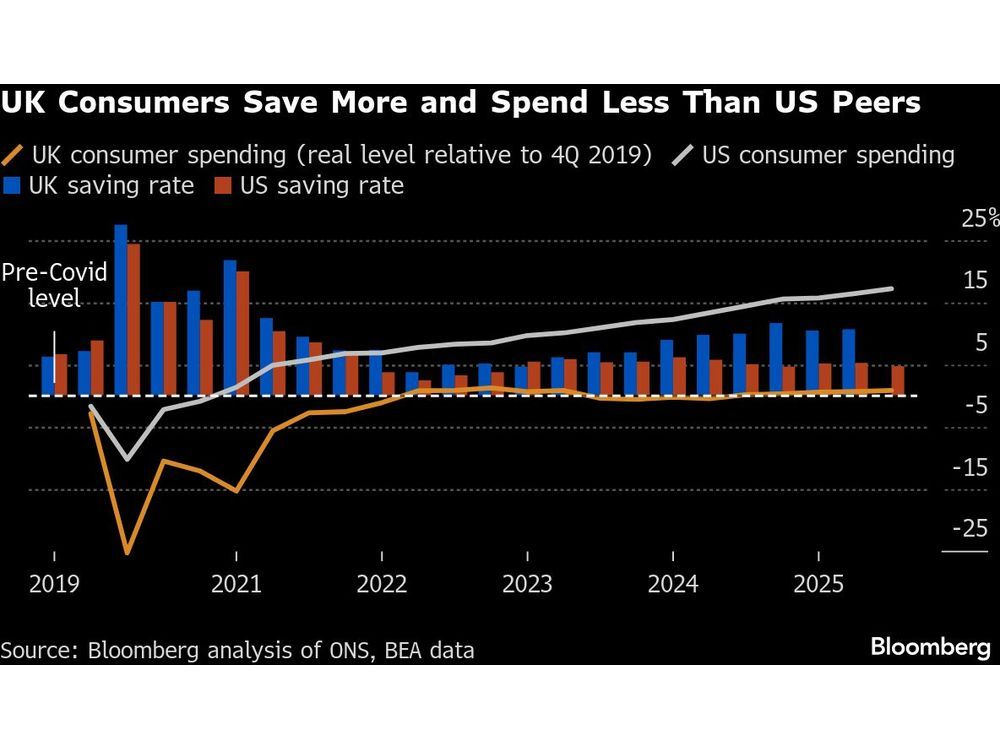
UK households are increasingly hoarding cash rather than spending it, as a sense of financial insecurity looms. According to a recent analysis by Michael Saunders, a senior advisor at Oxford Economics, the trend reflects the lasting impact of economic shocks over the past five years. With the festive season approaching, this growing reluctance to spend raises concerns for retailers and suppliers.
In his paper, Saunders highlighted that Britons are saving a larger portion of their income due to fears they do not have enough set aside for emergencies. The environment of higher interest rates, which makes saving more attractive, further contributes to this behavior. Official figures released on October 2023 indicated that the UK economy contracted for a second consecutive month, heightening worries about the potential for its first quarterly downturn in two years.
Consumer spending is critical for economic growth, accounting for approximately 60% of national output. However, it has stagnated for the past three years, posing a significant drag on the economy. This stands in stark contrast to the United States, where consumer expenditure has fueled robust economic growth among the Group of Seven nations. A revival in household spending is essential for maintaining the tax revenues that Chancellor of the Exchequer Rachel Reeves requires to execute her budget plans.
Saunders noted that households have been deeply affected by the pandemic and the subsequent cost-of-living crisis, which saw inflation peak at over 11% in late 2022, coupled with rising mortgage rates. While the average household possesses more savings than prior to the pandemic, many continue to set aside a historically high proportion of their disposable income.
“Even though the median level of liquid assets is higher now than the pre-pandemic period, the share of households who say they don’t have enough savings for emergencies has risen markedly,” Saunders stated. He pointed out that current saving rates are about 2.5 percentage points higher than the long-term average, particularly among individuals aged 25 to 55, renters, and those with minimal savings.
The Bank of England anticipates only a modest decrease in the current saving rate of over 10% in the coming years. Governor Andrew Bailey recently acknowledged consumers’ “high level of caution” amid ongoing uncertainty. Market projections suggest a quarter-point cut in interest rates on December 18, bringing them down to 3.75%, with expectations of further adjustments thereafter.
Saunders utilized “micro data” from the Bank of England’s annual NMG survey of around 6,000 households, conducted since 2010, to analyze the reasons behind the UK’s cautious consumption habits. Interestingly, pensioners have not been as adversely affected by recent economic challenges. “Financial insecurity has fallen among the over 65s, probably because the triple lock has protected pension income and with higher levels of assets they have benefited from higher interest rates,” he explained.
Historical patterns indicate that significant economic shocks often lead to increased precautionary saving. Saunders referenced past episodes of extreme volatility, such as the Great Depression in the 1930s and the inflation surge in the 1970s in the UK, which created similar behavioral changes among consumers.
A separate survey conducted by consulting firm RSM involving 2,000 consumers revealed that if presented with a one-off windfall of £5,000 ($6,673.5), nearly 57% would choose to save it or pay down debt, while only 8% indicated they would use it for Christmas presents.
As the holiday season approaches, the combination of increased savings and consumer hesitance poses significant challenges for retailers, who rely on this crucial trading period for their financial health. The overall sentiment suggests that without a shift in consumer confidence, the festive season may not deliver the economic boost many hope for.

iShares Core Dividend Growth ETF Faces Challenges; Alternatives Suggested

Discover 7 Scenic Hikes Near Calgary to Explore This Spring

Scientists Uncover Life’s Building Blocks in Ryugu Asteroid Samples

Windsor-Essex Unveils New Action Plan to Combat Substance Use

Boost Your Business Visibility with These Local SEO Strategies

East Algoma OPP Urges Public to Limit Travel Amid Hazardous Conditions

Universities Must Rethink Failure to Support Student Growth

Canada Invests $6.4 Million to Boost Green Shipping Corridors

Stony Plain Secures 14th Consecutive Award for Financial Reporting Excellence

Rhythm Pharmaceuticals Reports Strong Q4 Growth Ahead of FDA Decision

Brandon University’s Failed $5 Million Project Sparks Oversight Review

Microsoft Confirms U.S. Law Overrules Canadian Data Sovereignty

Winnipeg Celebrates Culinary Creativity During Le Burger Week 2025

Discover Aritzia’s Latest Fashion Trends: A Comprehensive Review

New SĆIȺNEW̱ SṮEȽIṮḴEȽ Elementary Opens in Langford for 2025/2026 Year

EngineAI Unveils T800 Humanoid Robot, Setting New Industry Standards

Montreal’s Groupe Marcelle Leads Canadian Cosmetic Industry Growth

Tech Innovator Amandipp Singh Transforms Hiring for Disabled

Dragon Ball: Sparking! Zero Launching on Switch and Switch 2 This November

Digg Relaunches as Founders Kevin Rose and Alexis Ohanian Join Forces
-
 Education7 months ago
Brandon University’s Failed $5 Million Project Sparks Oversight Review
-
 Science8 months ago
Microsoft Confirms U.S. Law Overrules Canadian Data Sovereignty
-
 Lifestyle7 months ago
Winnipeg Celebrates Culinary Creativity During Le Burger Week 2025
-
 Lifestyle4 months ago
Discover Aritzia’s Latest Fashion Trends: A Comprehensive Review
-
 Education7 months ago
New SĆIȺNEW̱ SṮEȽIṮḴEȽ Elementary Opens in Langford for 2025/2026 Year
-
 Business4 months ago
EngineAI Unveils T800 Humanoid Robot, Setting New Industry Standards
-
 Health8 months ago
Montreal’s Groupe Marcelle Leads Canadian Cosmetic Industry Growth
-
 Science8 months ago
Tech Innovator Amandipp Singh Transforms Hiring for Disabled
-
 Technology8 months ago
Dragon Ball: Sparking! Zero Launching on Switch and Switch 2 This November
-
 Technology3 months ago
Digg Relaunches as Founders Kevin Rose and Alexis Ohanian Join Forces
-
 Top Stories4 months ago
Canadiens Eye Elias Pettersson: What It Would Cost to Acquire Him
-

 Lifestyle4 weeks ago
Canmore’s Le Fournil Bakery to Close After 14 Successful Years
-

 Health7 months ago
Eganville Leader to Close in 2026 After 123 Years of Reporting
-

 Education8 months ago
Red River College Launches New Programs to Address Industry Needs
-

 Top Stories4 months ago
Nicol Brothers Shine as Wheat Kings Dominate U18 AAA Hockey
-

 Business7 months ago
Rocket Lab Reports Strong Q2 2025 Revenue Growth and Future Plans
-

 Business8 months ago
BNA Brewing to Open New Bowling Alley in Downtown Penticton
-

 Education6 months ago
Alberta Petition Aims to Redirect Funds from Private to Public Schools
-

 Education8 months ago
Alberta Teachers’ Strike: Potential Impacts on Students and Families
-

 Technology6 months ago
Discord Faces Serious Security Breach Affecting Millions
-

 Technology8 months ago
Google Pixel 10 Pro Fold Specs Unveiled Ahead of Launch
-

 Lifestyle5 months ago
Edmonton’s Beloved Evolution Wonderlounge Closes, New Era Begins
-

 Business7 months ago
Iconic Golden Lion Restaurant in South Surrey to Close After 50 Years
-

 Science8 months ago
China’s Wukong Spacesuit Sets New Standard for AI in Space