
Science
New Data Highlights Racial Disparities in Halton Policing

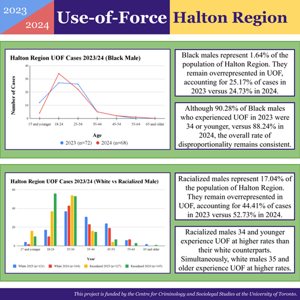
Research funded by the University of Toronto has uncovered significant racial disparities in policing practices in Halton, Ontario, raising critical questions about accountability and community relations. Conducted by Kojo Damptey, a PhD student and sessional instructor at McMaster University, the study analyzed police use-of-force data across 17 cities and regions in Ontario, revealing persistent patterns of racial disproportionality that particularly affect Black and Indigenous communities.
In Halton, Black males represent approximately 1.6% of the population but accounted for a staggering 25.2% of use-of-force incidents in 2023 and 24.7% in 2024. While there was a slight decrease over the year, Damptey emphasizes that the overall rate of disproportionality remains alarmingly high. Notably, a significant majority of those affected are young Black men; in 2023, 90.3% of Black males subjected to use of force were aged 34 or younger, with that figure slightly declining to 88.2% in the following year.
Contextualizing the Data
Damptey highlights that many police encounters begin not with criminal activity but through perceptions of who belongs in certain spaces. “Young Black and racialized men in certain places — people feel like they shouldn’t be there, so they call the police,” he explained. This often leads to situations where officers respond to reports of “suspicious” behavior that, upon investigation, typically turn out to be benign.
He pointed out that stereotypes play a significant role in why Black and racialized communities are overrepresented in use-of-force data. “We continue to see the same stereotypes,” Damptey noted, referencing instances where neighbors call law enforcement upon seeing a Black man wearing a hoodie.
Burlington Local-News.ca also sought comments from Stephen J. Tanner, Chief of the Halton Regional Police Service, who provided insight into the generation of use-of-force statistics. He indicated that many reports stem from collaborative operations across the Greater Toronto Area (GTA). “A lot of our use-of-force reports come from joint operations outside of Halton,” Tanner explained, citing involvement in large-scale investigations related to gangs, guns, and organized crime.
He pointed out that many individuals involved in these incidents are not residents of Halton but are instead arrested in the region during investigations. “They come in, commit serious crimes, and that goes into our statistics,” Tanner noted, acknowledging how such dynamics can skew the data when compared to local demographics.
Broader Implications and Community Response
Damptey stresses that “use of force” encompasses a wide range of actions, from drawing a taser to lethal force. This spectrum of actions explains why young people are so frequently represented in these statistics. The presence of police can escalate situations, especially when youths feel unfairly targeted.
The effectiveness of de-escalation training is also under scrutiny. Damptey argues that the definition of de-escalation used by police does not always align with community needs. “De-escalation, as police define it, isn’t necessarily about having a conversation,” he asserted, suggesting that different forms of force may be employed under this guise.
Despite the troubling data, Tanner asserts that use of force incidents are rare compared to the volume of police interactions. “When you think about the hundreds of thousands of interactions our officers have, the number of situations where use of force is reported in Halton is actually quite low,” he said.
The findings have also influenced how Black-led organizations in Halton engage with law enforcement. In December, the Halton Regional Police Service Youth Advisory Council reached out to Halton Black Voices to discuss potential collaboration. The organization declined, citing a history of mistrust stemming from negative experiences with policing. “At this time, we would not be able to move forward with a meeting or collaboration,” Halton Black Voices stated, emphasizing the need for community-led spaces where Black youth can heal without the pressure of surveillance.
Burlington Local-News.ca has reached out to the Halton Regional Police Board for comments on addressing these statistics and improving police-community relations. The board confirmed it would respond next week.
Damptey argues that the data highlights the need for structural accountability within policing. He criticizes diversity, equity, and inclusion training that fails to address systemic biases. “If we’re not seeing a change in the numbers, then the training is faulty,” he said, underscoring the critical nature of comprehensive reform.
Ontario’s Anti-Racism Act mandates public institutions, including police services, to collect race-based data to track discrimination. While this data is released annually, Damptey points out that it relies on perceived race rather than self-identification, which raises further concerns about accountability. “Police services should have an internal action plan to address this gross overrepresentation,” he said.
In April 2025, all police services in Ontario are required to release their use-of-force data, and Damptey maintains that transparency will be essential. “This data exists so communities can hold institutions accountable year after year,” he concluded.

Syilx Okanagan Women Reclaim Language Through QR Code Innovation

Malaysia Halts Access to Musk’s Grok AI Over Inappropriate Content

North Vancouver Pharmacy Celebrates Over 100 Years of Service

Alabama Proposes Digital Driver’s Licenses for Residents in 2026

Freddie Freeman Withdraws from 2026 World Baseball Classic

Windsor-Essex Students Explore Career Paths Through Co-op Program

Sault Ste. Marie Teen Excels in Theatre and Student Leadership

Malaysia Blocks Access to Elon Musk’s Grok AI Over Obscene Content

Q-tips: The Versatile Cotton Swab’s Evolution and Uses

Citizens Urged to Prioritize AI Impact Amid Local Issues

Brandon University’s Failed $5 Million Project Sparks Oversight Review

Microsoft Confirms U.S. Law Overrules Canadian Data Sovereignty

Winnipeg Celebrates Culinary Creativity During Le Burger Week 2025

Montreal’s Groupe Marcelle Leads Canadian Cosmetic Industry Growth

Tech Innovator Amandipp Singh Transforms Hiring for Disabled

Dragon Ball: Sparking! Zero Launching on Switch and Switch 2 This November

New SĆIȺNEW̱ SṮEȽIṮḴEȽ Elementary Opens in Langford for 2025/2026 Year

Red River College Launches New Programs to Address Industry Needs

Rocket Lab Reports Strong Q2 2025 Revenue Growth and Future Plans

Google Pixel 10 Pro Fold Specs Unveiled Ahead of Launch
-
 Education4 months ago
Brandon University’s Failed $5 Million Project Sparks Oversight Review
-
 Science5 months ago
Microsoft Confirms U.S. Law Overrules Canadian Data Sovereignty
-
 Lifestyle4 months ago
Winnipeg Celebrates Culinary Creativity During Le Burger Week 2025
-
 Health5 months ago
Montreal’s Groupe Marcelle Leads Canadian Cosmetic Industry Growth
-
 Science5 months ago
Tech Innovator Amandipp Singh Transforms Hiring for Disabled
-
 Technology5 months ago
Dragon Ball: Sparking! Zero Launching on Switch and Switch 2 This November
-
 Education5 months ago
New SĆIȺNEW̱ SṮEȽIṮḴEȽ Elementary Opens in Langford for 2025/2026 Year
-
 Education5 months ago
Red River College Launches New Programs to Address Industry Needs
-
 Business4 months ago
Rocket Lab Reports Strong Q2 2025 Revenue Growth and Future Plans
-
 Technology5 months ago
Google Pixel 10 Pro Fold Specs Unveiled Ahead of Launch
-
 Top Stories4 weeks ago
Canadiens Eye Elias Pettersson: What It Would Cost to Acquire Him
-

 Technology3 months ago
Discord Faces Serious Security Breach Affecting Millions
-

 Education5 months ago
Alberta Teachers’ Strike: Potential Impacts on Students and Families
-

 Business1 month ago
EngineAI Unveils T800 Humanoid Robot, Setting New Industry Standards
-

 Business5 months ago
BNA Brewing to Open New Bowling Alley in Downtown Penticton
-

 Science5 months ago
China’s Wukong Spacesuit Sets New Standard for AI in Space
-

 Lifestyle3 months ago
Canadian Author Secures Funding to Write Book Without Financial Strain
-

 Business5 months ago
New Estimates Reveal ChatGPT-5 Energy Use Could Soar
-

 Business5 months ago
Dawson City Residents Rally Around Buy Canadian Movement
-

 Business3 months ago
Hydro-Québec Espionage Trial Exposes Internal Oversight Failures
-

 Technology5 months ago
Future Entertainment Launches DDoD with Gameplay Trailer Showcase
-

 Top Stories4 months ago
Blue Jays Shift José Berríos to Bullpen Ahead of Playoffs
-

 Technology5 months ago
World of Warcraft Players Buzz Over 19-Quest Bee Challenge
-

 Top Stories3 months ago
Patrik Laine Struggles to Make Impact for Canadiens Early Season