
Science
Astronomers Unveil ‘Cloud-9’: A Potential Dark Matter Discovery

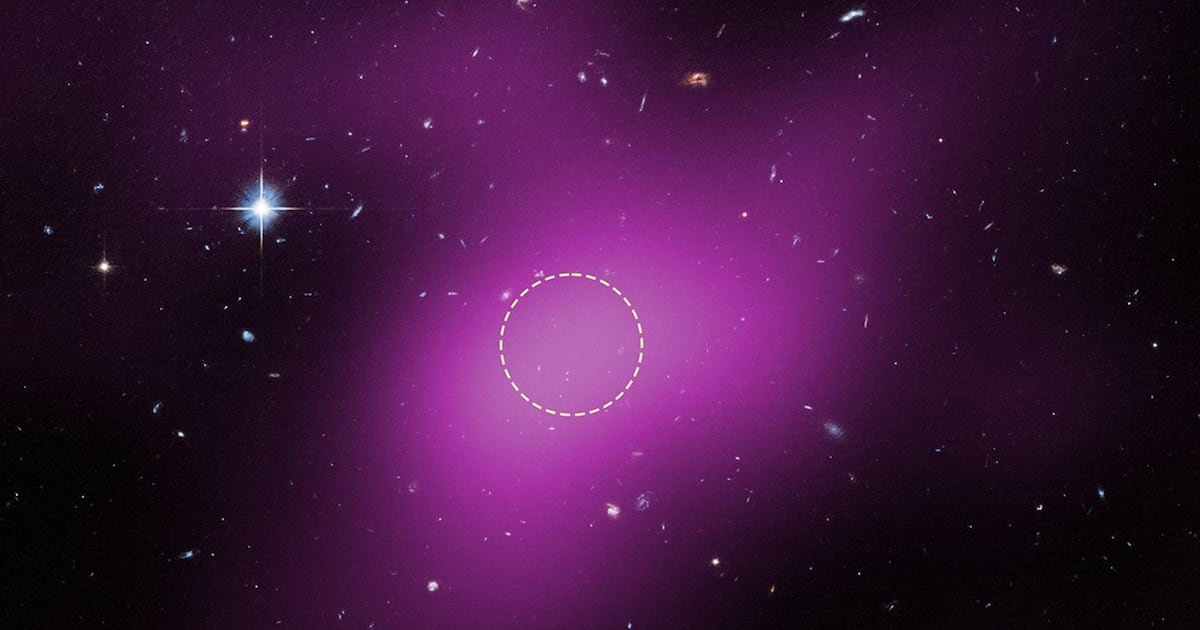
Astronomers have identified a newly discovered celestial object, referred to as “Cloud-9,” which may offer critical insights into the elusive nature of dark matter. This groundbreaking discovery, detailed in a recent publication in The Astrophysical Journal Letters, suggests that Cloud-9 could represent a dark matter cloud, potentially a remnant from the early universe. Dark matter is believed to constitute approximately 85 percent of the universe’s total matter, although it has never been directly observed.
According to study coauthor Andrew Fox, an astronomer at the Space Telescope Science Institute in Baltimore, Cloud-9 presents a unique opportunity to examine the dark universe. Fox emphasized, “We know from theory that most of the mass in the universe is expected to be dark matter, but it’s difficult to detect this dark material because it doesn’t emit light. Cloud-9 gives us a rare look at a dark-matter-dominated cloud.”
Theoretical frameworks suggest that dark matter originated from the Big Bang, which occurred approximately 13.8 billion years ago. It is thought to form cosmic clouds that lack the necessary gas to ignite star formation. Observations made with the Hubble Space Telescope confirmed that Cloud-9 is devoid of stars, reinforcing its classification as a failed galaxy.
“This is a tale of a failed galaxy,” noted study coauthor Alejandro Benitez-Llambay, an astrophysicist and assistant professor at the University of Milano-Bicocca in Milan, Italy. “In science, we usually learn more from failures than from successes. In this case, seeing no stars is what proves the theory right. It tells us that we have found in the local universe a primordial building block of a galaxy that hasn’t formed.”
The journey to uncovering Cloud-9 began three years ago during a survey of hydrogen gas near the spiral galaxy Messier 94, utilizing the Five-hundred-meter Aperture Spherical Telescope (FAST) located in China’s Guizhou province. Follow-up observations with the Green Bank Telescope and the Very Large Array confirmed the starless nature of the cloud.
Fox explained that theories of galaxy formation indicate there is a minimum threshold of dark matter needed to spark star formation. Cloud-9 represents an example of an object just below this threshold, containing no stars. The object received its nickname as it is the ninth gas cloud identified in proximity to Messier 94.
The core of Cloud-9 is composed predominantly of neutral hydrogen, spanning approximately 4,900 light-years in diameter. This distance is equivalent to about 5.88 trillion miles (or 9.46 trillion kilometers). The hydrogen mass within the cloud is estimated to be around 1 million times the mass of the Sun, with an additional 5 billion solar masses of dark matter contributing to its structure.
“There must be a massive amount of ‘invisible’ gravity holding it together,” stated study coauthor Dr. Rachel Beaton, an assistant astronomer at the Space Telescope Science Institute. She elaborated that the visible neutral hydrogen does not provide sufficient mass, implying a dark matter halo that offers the necessary gravitational support for the cloud.
Cloud-9 currently exists in a delicate balance, according to Beaton. “It has just enough mass to hold onto its gas, but not quite enough to force that gas into star formation,” she explained. This rarity may explain the limited number of similar objects observed in the local universe, as most halos either lose their gas entirely or evolve into full-fledged galaxies.
The future of Cloud-9 remains uncertain, as it may eventually accumulate more mass and transform into a galaxy, or it could lose mass if it approaches Messier 94, leading to its dissolution. Fox remarked, “If the cloud loses mass, it could happen if it falls closer in toward M94, and its gas gets stripped like a cloud in a wind tunnel until the cloud ceases to exist.”
Advanced observational techniques could provide pivotal insights into the core of Cloud-9, potentially revealing the quantity of dark matter contained within. Beaton highlighted that this could help narrow down the characteristics of dark matter particles using astrophysical data.
While Cloud-9 presents an intriguing case, it is not the first object discussed in connection with “dark galaxies.” Dr. Jacco van Loon, an associate professor of astrophysics at Keele University in England, cautioned against drawing definitive conclusions about Cloud-9’s nature without stronger evidence. He noted that another hydrogen cloud, FAST J0139+4328, was recently identified as a faint galaxy, suggesting that Cloud-9 could also harbor a similar unobserved structure.
The research team continues to search for additional objects like Cloud-9 to better understand whether it is an anomaly or part of a broader category of cosmic relics. Dr. Kristine Spekkens, a professor of astronomy at Queen’s University in Kingston, Ontario, remarked on the importance of ongoing investigations. “Further study of this starless gas, such as its unusual shape, will help unravel its origin as a starless galaxy or a free-floating cloud,” she stated.
As astronomers delve deeper into the mysteries of the universe, Cloud-9 stands as a compelling example of the potential discoveries awaiting in the vastness of space.

iShares Core Dividend Growth ETF Faces Challenges; Alternatives Suggested

Discover 7 Scenic Hikes Near Calgary to Explore This Spring

Scientists Uncover Life’s Building Blocks in Ryugu Asteroid Samples

Windsor-Essex Unveils New Action Plan to Combat Substance Use

Boost Your Business Visibility with These Local SEO Strategies

East Algoma OPP Urges Public to Limit Travel Amid Hazardous Conditions

Universities Must Rethink Failure to Support Student Growth

Canada Invests $6.4 Million to Boost Green Shipping Corridors

Stony Plain Secures 14th Consecutive Award for Financial Reporting Excellence

Rhythm Pharmaceuticals Reports Strong Q4 Growth Ahead of FDA Decision

Brandon University’s Failed $5 Million Project Sparks Oversight Review

Microsoft Confirms U.S. Law Overrules Canadian Data Sovereignty

Winnipeg Celebrates Culinary Creativity During Le Burger Week 2025

Discover Aritzia’s Latest Fashion Trends: A Comprehensive Review

New SĆIȺNEW̱ SṮEȽIṮḴEȽ Elementary Opens in Langford for 2025/2026 Year

EngineAI Unveils T800 Humanoid Robot, Setting New Industry Standards

Montreal’s Groupe Marcelle Leads Canadian Cosmetic Industry Growth

Tech Innovator Amandipp Singh Transforms Hiring for Disabled

Dragon Ball: Sparking! Zero Launching on Switch and Switch 2 This November

Digg Relaunches as Founders Kevin Rose and Alexis Ohanian Join Forces
-
 Education7 months ago
Brandon University’s Failed $5 Million Project Sparks Oversight Review
-
 Science8 months ago
Microsoft Confirms U.S. Law Overrules Canadian Data Sovereignty
-
 Lifestyle7 months ago
Winnipeg Celebrates Culinary Creativity During Le Burger Week 2025
-
 Lifestyle4 months ago
Discover Aritzia’s Latest Fashion Trends: A Comprehensive Review
-
 Education8 months ago
New SĆIȺNEW̱ SṮEȽIṮḴEȽ Elementary Opens in Langford for 2025/2026 Year
-
 Business4 months ago
EngineAI Unveils T800 Humanoid Robot, Setting New Industry Standards
-
 Health8 months ago
Montreal’s Groupe Marcelle Leads Canadian Cosmetic Industry Growth
-
 Science8 months ago
Tech Innovator Amandipp Singh Transforms Hiring for Disabled
-
 Technology8 months ago
Dragon Ball: Sparking! Zero Launching on Switch and Switch 2 This November
-
 Technology3 months ago
Digg Relaunches as Founders Kevin Rose and Alexis Ohanian Join Forces
-

 Lifestyle4 weeks ago
Canmore’s Le Fournil Bakery to Close After 14 Successful Years
-
 Top Stories4 months ago
Canadiens Eye Elias Pettersson: What It Would Cost to Acquire Him
-
 Health7 months ago
Eganville Leader to Close in 2026 After 123 Years of Reporting
-

 Education8 months ago
Red River College Launches New Programs to Address Industry Needs
-

 Business8 months ago
BNA Brewing to Open New Bowling Alley in Downtown Penticton
-

 Top Stories4 months ago
Nicol Brothers Shine as Wheat Kings Dominate U18 AAA Hockey
-

 Business7 months ago
Rocket Lab Reports Strong Q2 2025 Revenue Growth and Future Plans
-

 Lifestyle5 months ago
Edmonton’s Beloved Evolution Wonderlounge Closes, New Era Begins
-

 Education6 months ago
Alberta Petition Aims to Redirect Funds from Private to Public Schools
-

 Education8 months ago
Alberta Teachers’ Strike: Potential Impacts on Students and Families
-

 Technology6 months ago
Discord Faces Serious Security Breach Affecting Millions
-

 Technology8 months ago
Google Pixel 10 Pro Fold Specs Unveiled Ahead of Launch
-

 Business8 months ago
Iconic Golden Lion Restaurant in South Surrey to Close After 50 Years
-

 Lifestyle6 months ago
Canadian Author Secures Funding to Write Book Without Financial Strain