
Health
Canadians Face Record Health Care Delays, Manitoba Shows Mixed Results

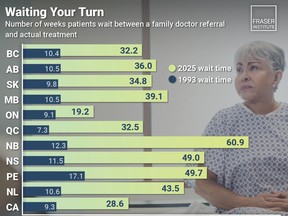
Canadians are grappling with prolonged delays for essential health care, as a new report reveals that patients are waiting an average of over six months from a family doctor referral to treatment. The study, titled Waiting Your Turn: Wait Times for Health Care in Canada, 2025, published by the Fraser Institute, outlines that in 2025, patients faced a median wait time of 28.6 weeks from referral to treatment. This figure, while an improvement from 30.0 weeks in 2024, marks the second-longest wait time in the institute’s 34-year history.
According to Nadeem Esmail, director of health policy studies at the Fraser Institute and co-author of the report, “Remarkably long wait times for medically necessary care have become the defining characteristic of the Canadian health-care experience.” The annual survey is based on feedback from physicians across ten provinces and twelve medical specialties, illustrating that current wait times are now 208% longer than in 1993, when the median wait was just 9.3 weeks.
Manitoba’s Position in the Health Care Landscape
While Manitoba did not rank among the provinces with the shortest overall wait times, it did exhibit better performance concerning the second stage of care, which encompasses the period between seeing a specialist and receiving treatment. In this regard, Manitoba recorded a median wait of 15.7 weeks, making it one of the provinces with shorter waits nationally. Only Ontario (8.5 weeks) and British Columbia (12.4 weeks) reported quicker access during this phase.
Despite this relative success, Manitobans continue to encounter delays earlier in the health care system. Nationally, the wait time between a family doctor’s referral and consultation with a specialist rose slightly in 2025 to 15.3 weeks, reflecting a persistent upward trend that has raised concerns among health officials.
Disparities Across Provinces and Specialties
The report highlights significant disparities in wait times across Canada. Ontario reported the shortest overall median wait time at 19.2 weeks, while New Brunswick faced the longest at 60.9 weeks. Other provinces, such as Prince Edward Island (49.7 weeks) and Nova Scotia (49.0 weeks), also observed patients waiting nearly a full year for care. In total, an estimated 1.4 million Canadians were waiting for medically necessary procedures in 2025.
Wait times varied significantly based on the type of care required. Nationally, patients experienced the longest delays for neurosurgery, averaging 49.9 weeks, and orthopaedic surgery at 48.6 weeks. These procedures are often associated with chronic pain and mobility issues, impacting patients’ quality of life. In contrast, wait times for radiation oncology and medical oncology were considerably shorter, at just 4.2 weeks and 4.7 weeks, respectively.
Even after patients consult with a specialist, they are facing wait times that exceed what medical professionals consider clinically reasonable by an average of 4.5 weeks. As Mackenzie Moir, senior policy analyst at the Fraser Institute and co-author of the study, stated, “Long wait times can result in increased suffering for patients, lost productivity at work, decreased quality of life, and in the worst cases, disability or death.”
The report further indicates ongoing delays in diagnostic imaging, a crucial component of diagnosis and treatment planning. In 2025, patients waited a median of 8.8 weeks for CT scans, 18.1 weeks for MRI scans, and 5.4 weeks for ultrasounds. The delays for MRI scans were particularly concerning, with some provinces reporting waits extending several months.
As Canada continues to confront these challenges within its health care system, the implications of these delays resonate across communities, affecting not only patient health but also broader societal productivity and well-being.

iShares Core Dividend Growth ETF Faces Challenges; Alternatives Suggested

Discover 7 Scenic Hikes Near Calgary to Explore This Spring

Scientists Uncover Life’s Building Blocks in Ryugu Asteroid Samples

Windsor-Essex Unveils New Action Plan to Combat Substance Use

Boost Your Business Visibility with These Local SEO Strategies

East Algoma OPP Urges Public to Limit Travel Amid Hazardous Conditions

Universities Must Rethink Failure to Support Student Growth

Canada Invests $6.4 Million to Boost Green Shipping Corridors

Stony Plain Secures 14th Consecutive Award for Financial Reporting Excellence

Rhythm Pharmaceuticals Reports Strong Q4 Growth Ahead of FDA Decision

Brandon University’s Failed $5 Million Project Sparks Oversight Review

Microsoft Confirms U.S. Law Overrules Canadian Data Sovereignty

Winnipeg Celebrates Culinary Creativity During Le Burger Week 2025

Discover Aritzia’s Latest Fashion Trends: A Comprehensive Review

New SĆIȺNEW̱ SṮEȽIṮḴEȽ Elementary Opens in Langford for 2025/2026 Year

EngineAI Unveils T800 Humanoid Robot, Setting New Industry Standards

Montreal’s Groupe Marcelle Leads Canadian Cosmetic Industry Growth

Tech Innovator Amandipp Singh Transforms Hiring for Disabled

Dragon Ball: Sparking! Zero Launching on Switch and Switch 2 This November

Digg Relaunches as Founders Kevin Rose and Alexis Ohanian Join Forces
-
 Education7 months ago
Brandon University’s Failed $5 Million Project Sparks Oversight Review
-
 Science8 months ago
Microsoft Confirms U.S. Law Overrules Canadian Data Sovereignty
-
 Lifestyle7 months ago
Winnipeg Celebrates Culinary Creativity During Le Burger Week 2025
-
 Lifestyle4 months ago
Discover Aritzia’s Latest Fashion Trends: A Comprehensive Review
-
 Education7 months ago
New SĆIȺNEW̱ SṮEȽIṮḴEȽ Elementary Opens in Langford for 2025/2026 Year
-
 Business4 months ago
EngineAI Unveils T800 Humanoid Robot, Setting New Industry Standards
-
 Health8 months ago
Montreal’s Groupe Marcelle Leads Canadian Cosmetic Industry Growth
-
 Science8 months ago
Tech Innovator Amandipp Singh Transforms Hiring for Disabled
-
 Technology8 months ago
Dragon Ball: Sparking! Zero Launching on Switch and Switch 2 This November
-
 Technology3 months ago
Digg Relaunches as Founders Kevin Rose and Alexis Ohanian Join Forces
-
 Top Stories4 months ago
Canadiens Eye Elias Pettersson: What It Would Cost to Acquire Him
-

 Lifestyle4 weeks ago
Canmore’s Le Fournil Bakery to Close After 14 Successful Years
-

 Health7 months ago
Eganville Leader to Close in 2026 After 123 Years of Reporting
-

 Education8 months ago
Red River College Launches New Programs to Address Industry Needs
-

 Top Stories4 months ago
Nicol Brothers Shine as Wheat Kings Dominate U18 AAA Hockey
-

 Business7 months ago
Rocket Lab Reports Strong Q2 2025 Revenue Growth and Future Plans
-

 Business8 months ago
BNA Brewing to Open New Bowling Alley in Downtown Penticton
-

 Education6 months ago
Alberta Petition Aims to Redirect Funds from Private to Public Schools
-

 Lifestyle5 months ago
Edmonton’s Beloved Evolution Wonderlounge Closes, New Era Begins
-

 Education8 months ago
Alberta Teachers’ Strike: Potential Impacts on Students and Families
-

 Technology6 months ago
Discord Faces Serious Security Breach Affecting Millions
-

 Technology8 months ago
Google Pixel 10 Pro Fold Specs Unveiled Ahead of Launch
-

 Business7 months ago
Iconic Golden Lion Restaurant in South Surrey to Close After 50 Years
-

 Science8 months ago
China’s Wukong Spacesuit Sets New Standard for AI in Space