
Business
Quebec’s Economy Adapts Amid U.S. Tariffs and Trade Uncertainty

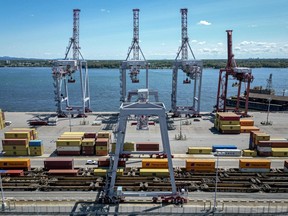
Quebec’s economy has demonstrated resilience as it navigates the challenges posed by U.S. tariffs and ongoing trade uncertainty under President Donald Trump. Despite fears of an economic downturn, the province’s exports have continued to flow predominantly to the United States, contributing to modest economic growth.
Over the past year, businesses in Quebec have had to adjust their strategies in response to Trump’s administration, which imposed a series of tariffs on Canadian goods. These tariffs began at 25 percent and were later raised to 35 percent. In the wake of these changes, many Quebec companies paused investments and looked for alternative markets.
Fortunately, a significant number of Quebec’s exports have remained exempt from these tariffs due to compliance with the Canada-United States-Mexico Agreement (CUSMA). This exemption has been described as “critical” for the province’s manufacturing sector by Julie White, CEO of Manufacturiers & Exportateurs du Québec. She noted that while uncertainty persists, the exemption has allowed many businesses to maintain operations despite lower margins and revenues.
However, challenges remain. Certain sectors continue to face significant tariffs, particularly steel and aluminum, which are subject to a 50 percent duty when exported to the U.S. Additionally, softwood lumber exports, already burdened by a 35 percent tariff, saw an extra 10 percent added in October. Tariffs on products made from Canadian lumber have also created hurdles, with kitchen cabinets facing a 25 percent tariff that was scheduled to increase to 50 percent at the start of the year, only to be paused by Trump on New Year’s Eve.
As Charlotte Laramée, president and CEO of industry group AluQuebec, explained, the impact of these tariffs on small- and medium-sized businesses that process aluminum has been particularly acute. Many of these companies, employing approximately 30,000 of the 40,000 individuals in Quebec’s aluminum sector, are adapting their business models. Some have had to lay off workers, while others are shifting towards higher-value products that are easier to export internationally.
Despite these challenges, there is optimism about potential new opportunities. Laramée highlighted the importance of maintaining access to the U.S. market, emphasizing the intertwined nature of the North American aluminum value chain. Many Quebec businesses are exploring new markets and sectors, including infrastructure and defense, as they seek to diversify their export strategies.
Statistics show that Quebec’s exports to the U.S. have declined, with a reported decrease of 16.7 percent during the first three quarters of 2025 compared to the same period in 2024. Overall, total exports to the U.S. were down by 5.3 percent, with the province’s total exports to all countries declining by 1.6 percent. Nonetheless, Quebec’s economy grew by approximately 1.1 percent during the same timeframe, according to the Institut de la statistique du Québec.
Looking ahead, the upcoming review of CUSMA in July presents a crucial opportunity for Quebec’s exporters. White expressed hope that the review would reinforce the CUSMA exemption, allowing the agreement to remain a trilateral arrangement rather than devolving into separate bilateral deals. She noted the importance of stability in trade relations, particularly given the potential for U.S. political dynamics, including the mid-term elections scheduled for November 2024, to influence negotiations.
The effects of the ongoing trade tensions have also reverberated through Canadian federal politics. The situation has contributed to a strengthened Liberal government under Prime Minister Mark Carney, who has shifted focus toward economic policies and investments. In Quebec, the response to Trump’s presidency has fostered a heightened sense of Canadian identity, although discussions about sovereignty remain prevalent, particularly among younger populations.
On the ground, Quebec’s initiatives to reduce interprovincial trade barriers are gradually taking shape. White noted recent legislative progress aimed at recognizing certifications from other provinces, although cooperation from all provinces is required for such measures to be effective.
Despite positive steps, challenges persist. Jean-François Nellis, owner of the Pit Caribou microbrewery, articulated frustrations with the complexities of interprovincial trade. He remarked that selling products within Canada often proves more challenging than exporting to other countries, highlighting the need for continued efforts to streamline trade within the nation.
As Quebec grapples with the dual pressures of U.S. tariffs and evolving trade dynamics, the province’s adaptability will be crucial in sustaining economic growth and securing its position in North American markets.

Navigating Life’s Irritations: A Humorous Take on Aging

Saanich Implements Fixed-Fee Water Rate to Stabilize Budgets

Airdrie Town Hall Addresses Classroom Overcrowding Concerns

Saanich Shifts Water Rates to Fixed Fees to Stabilize Budgets

Mobile Clinic Launches to Support Rural Hospitals Near Ottawa

Canadian Doctors Warn U.S. Vaccine Cuts Could Endanger Health

Canada Dismisses Reports of Potential Ban on Social Media Platform X

Hawaii Enacts Law to Ensure Authentic Macadamia Nut Labeling

Richmond Launches Professional Development Series for Artists

SSENSE Co-Founders Secure Deal to Reacquire Luxury Retailer

Brandon University’s Failed $5 Million Project Sparks Oversight Review

Microsoft Confirms U.S. Law Overrules Canadian Data Sovereignty

Winnipeg Celebrates Culinary Creativity During Le Burger Week 2025

Montreal’s Groupe Marcelle Leads Canadian Cosmetic Industry Growth

Tech Innovator Amandipp Singh Transforms Hiring for Disabled

Dragon Ball: Sparking! Zero Launching on Switch and Switch 2 This November

New SĆIȺNEW̱ SṮEȽIṮḴEȽ Elementary Opens in Langford for 2025/2026 Year

Red River College Launches New Programs to Address Industry Needs

Rocket Lab Reports Strong Q2 2025 Revenue Growth and Future Plans

Google Pixel 10 Pro Fold Specs Unveiled Ahead of Launch
-
 Education4 months ago
Brandon University’s Failed $5 Million Project Sparks Oversight Review
-
 Science5 months ago
Microsoft Confirms U.S. Law Overrules Canadian Data Sovereignty
-
 Lifestyle4 months ago
Winnipeg Celebrates Culinary Creativity During Le Burger Week 2025
-
 Health5 months ago
Montreal’s Groupe Marcelle Leads Canadian Cosmetic Industry Growth
-
 Science5 months ago
Tech Innovator Amandipp Singh Transforms Hiring for Disabled
-
 Technology5 months ago
Dragon Ball: Sparking! Zero Launching on Switch and Switch 2 This November
-
 Education5 months ago
New SĆIȺNEW̱ SṮEȽIṮḴEȽ Elementary Opens in Langford for 2025/2026 Year
-
 Education5 months ago
Red River College Launches New Programs to Address Industry Needs
-
 Business4 months ago
Rocket Lab Reports Strong Q2 2025 Revenue Growth and Future Plans
-
 Technology5 months ago
Google Pixel 10 Pro Fold Specs Unveiled Ahead of Launch
-
 Top Stories4 weeks ago
Canadiens Eye Elias Pettersson: What It Would Cost to Acquire Him
-

 Technology3 months ago
Discord Faces Serious Security Breach Affecting Millions
-

 Education5 months ago
Alberta Teachers’ Strike: Potential Impacts on Students and Families
-

 Business1 month ago
EngineAI Unveils T800 Humanoid Robot, Setting New Industry Standards
-

 Business5 months ago
BNA Brewing to Open New Bowling Alley in Downtown Penticton
-

 Science5 months ago
China’s Wukong Spacesuit Sets New Standard for AI in Space
-

 Lifestyle3 months ago
Canadian Author Secures Funding to Write Book Without Financial Strain
-

 Business5 months ago
New Estimates Reveal ChatGPT-5 Energy Use Could Soar
-

 Business5 months ago
Dawson City Residents Rally Around Buy Canadian Movement
-

 Business3 months ago
Hydro-Québec Espionage Trial Exposes Internal Oversight Failures
-

 Technology5 months ago
Future Entertainment Launches DDoD with Gameplay Trailer Showcase
-

 Top Stories4 months ago
Blue Jays Shift José Berríos to Bullpen Ahead of Playoffs
-

 Technology5 months ago
World of Warcraft Players Buzz Over 19-Quest Bee Challenge
-

 Top Stories3 months ago
Patrik Laine Struggles to Make Impact for Canadiens Early Season